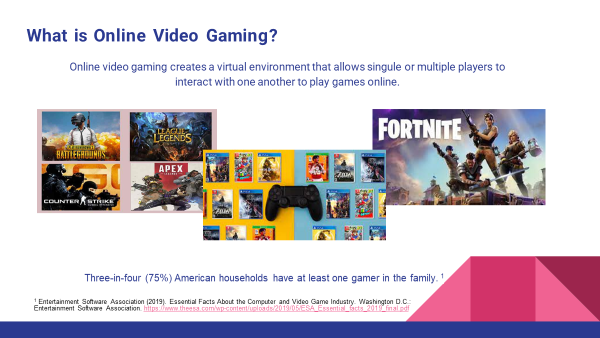
Video games have gained much popularity among teenagers, especially during the pandemic. Video game usage went up 75% amid the COVID-19 pandemic (Shanley, 2020), with the gaming industry earning $159.3 billion in 2020(Field Level Media, 2020). In fact 82% of global consumers played video games or watched video game play in March 2020 (Nielsen, 2020) during the height of pandemic lockdowns in the US. Research indicates that three-in-four (75%) American households have at least one gamer in the family (Entertainment Software Association, 2019). A majority (60%) of children and teens between the ages of 8 to 18 play video games every day and those who do play spend an average of two hours playing per day (Rideout, Foehr, Roberts, 2010). Generation Z males, those born in 1997 and after, are especially into video games. Nine-in ten (91%) Gen Z males play video games on a regular basis, and 68% say video games are a core part of their identity (Geena Davis Institute, 2021).
However, how video games perpetuate stereotyping and prejudice in teenagers 13-19 years of age is a relatively under-researched field in psychological studies. Research has already been done on how video games perpetuate violence, racial prejudice and discrimination against minorities (Deskins, 2013; Yang, Gibson, Lueke, Huesmann, & Bushman, 2014; Daniels & LaLone, 2012), gatekeep women, and create gender biases (Harris-Lowe, 2017; Derr, 2020) and enhance violence in video gamers (Przybylski, Ryan & Rigby, 2009; Wei, 2007; Ferguson, Gryshyna, Kim, Knowles, Nadeem, Cardozo & Willis, 2022; Suziedelyte, 2021).
The study, The Double-Edged Sword of Online Gaming (Geena Davis Institute, 2021), is the first systematic content analysis of U.S. representation in video games since 2009 and also the first study to analyze six major marginalized groups in US society, in gaming: women, people of color, LGBTQIA+ individuals, people with disabilities, adults ages 50+, and people with large body types. However, little has been done to study the impact of the online gaming world on teenagers and how stereotypes and prejudices are created in this environment. So, I decided to do more in depth research to investigate the effect online video games could have on perpetuating stereotypes and prejudices in teenagers. Over my next few blog posts I will provide an overview of online gaming, the different types of games, and further analysis on gaming behaviors. I also show how the online gaming world creates a different type of environment and has unique structures that accentuates stereotypes and prejudices. I then further explore the negative representations in online gaming – what we call the “isms in online gaming”, like racism, sexism, ageism and ableism. This will be researched through the lens of the social and psychological factors like cultural beliefs, exclusion or in-group favoritism and how they lead to the reinforcement of stereotypes and prejudices. The goal will be to provide an overview of the topic, along with supporting research studies, and then illustrate the need for further research in this area. Happy reading of all these blog posts!
Citations:
Daniels, J., & LaLone, N. (2012). Racism in video gaming: connecting extremist and mainstream expressions of white supremacy. Social exclusion, power, and video game play: new research in digital media and technology, 85-100.
Derr, T. M. (2020). The road to gamergate: the history of gender stereotyping in video game culture, 1970-2000 and beyond (Doctoral dissertation, Rutgers University-Graduate School-Newark).
Deskins, T. G. (2013). Stereotypes in video games and how they perpetuate prejudice. McNair Scholars Research Journal, 6(1), 5.
Entertainment Software Association (2019). Essential Facts About the Computer and Video Game Industry. Washington D.C.: Entertainment Software Association. https://www.theesa.com/wp-content/uploads/2019/05/ESA_Essential_facts_2019_final.pdf
Ferguson, C. J., Gryshyna, A., Kim, J. S., Knowles, E., Nadeem, Z., Cardozo, I., … & Willis, E. (2022). Video games, frustration, violence, and virtual reality: Two studies. British journal of social psychology, 61(1), 83-99.
Field Level Media (2020). Gaming revenue to top $159B in 2020. https://www.reuters.com/article/esports-businessgaming-revenues/report-gaming-revenue-to-top-159b-in-2020-idUSFLM8jkJMl
Geena Davis Institute, Oak Foundation, Promundo (2021) The Double-Edge Sword of Online Gaming. https://seejane.org/wp-content/uploads/gaming-study-2021-7.pdf
Harris-Lowe, B. (2017). Gatekeeping: Women, people of color, and the video game community.
Nielsen (2020). “3, 2, 1, Go! Video Gaming is at an All-Time High During COVID-19”. https://www.nielsen.com/insights/2020/3-2-1-go-video-gaming-is-at-an-all-time-high-during-covid-19/
Przybylski, A. K., Ryan, R. M., & Rigby, C. S. (2009). The motivating role of violence in video games. Personality and social psychology bulletin, 35(2), 243-259.
Rideout, V. J., Foehr, U. G., & Roberts, D. F. (2010). Generation M 2: Media in the Lives of 8-to 18-Year-Olds. Henry J. Kaiser Family Foundation.
Shanley, P. (2020). Gaming usage up 75 percent amid coronavirus outbreak, Verizon reports. The Hollywood Reporter.
Suziedelyte, A. (2021). Is it only a game? Video games and violence. Journal of Economic Behavior & Organization, 188, 105-125.
Wei, R. (2007). Effects of playing violent videogames on Chinese adolescents’ pro-violence attitudes, attitudes toward others, and aggressive behavior. Cyberpsychology & behavior, 10(3), 371-380.
Yang, G. S., Gibson, B., Lueke, A. K., Huesmann, L. R., & Bushman, B. J. (2014). Effects of avatar race in violent video games on racial attitudes and aggression. Social Psychological and Personality Science, 5(6), 698-704.
 Site Title