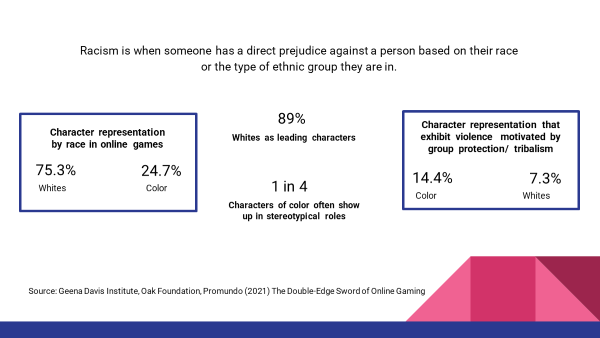
Racism is when someone has a direct prejudice against a person based on their race or the type of ethnic group they are in. Dominance of white supremacy and racial inequality is perpetuated in online video games. Nearly nine-in-ten (89%) leading characters are white and white characters outnumber characters of color three-to-one (75% compared with 24%) (Geena Davis Institute, 2021). This representation is less diverse than the US population, which consists of 40% people of color as of 2020 Census reports (Frey, 2021).
The way the characters of different races are portrayed and represented in online video games reinforces the stereotypes in the real world. Also, characters of color and different races often show up in games filling the same stereotypical roles of the real world. One-in-four characters of color appear as stereotypes (Geena Davis Institute, 2021). For example, in video games, Blacks are represented as sidekicks or being more violent or aggressive, Latinx characters are shown as gang members and Middle Eastern characters as terrorists.
When characters do enact violence, characters of color are twice as likely to be motivated by the protection of a group or tribe as opposed to personal gain or anger than white video game characters (14% compared with 7%) (Geena Davis Institute, 2021). Hence, this tends to create a perception in online video games that Blacks and Latinx characters exhibit more violence to protect their tribes, thus reinstating a stereotype from the real world.
Citations:
Frey, W. H. (2021). New 2020 census results show increased diversity countering decade-long declines in America’s white and youth populations. Brookings Institution Press. https://www.brookings.edu/research/new-2020-census-results-show-increased-diversity-countering-decade-long-declines-in-americas-white-and-youth-populations/
Geena Davis Institute, Oak Foundation, Promundo (2021) The Double-Edge Sword of Online Gaming. https://seejane.org/wp-content/uploads/gaming-study-2021-7.pdf
 Site Title