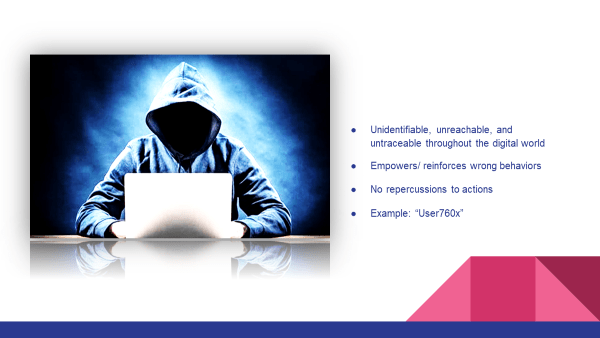
Anonymity means people are unidentifiable, unreachable, and untraceable throughout the digital world. Players who are anonymous tend to be more brutally honest. This can be positive as people can be more open with each other, but it also causes people to act out with harsh criticisms, anger, hatred, rude language, and even threats (Suler, 2004). Anonymity encourages both bullying and cheating within these communities and encourages other deviant behavior (Grazotis, 2018).
According to Suler (2004), “The vulnerability of these people is protected by anonymity and therefore may encourage negative actions, with users being able to disassociate their online persona from their offline personality and identity in order to avoid taking responsibility”. An example of this is instead of your real identity, one can have an ambiguous username like “User760x”, so others have no idea who you are, and you can get away with anything, including killing someone online.
Findings indicate that players who are anonymous online tend to be more aggressive because they have confidence about not getting caught and believe that online content is not permanent (Wright, 2013). Other issues like loss of credibility and influence also have been proven to arise from the presence of anonymity in online games (Rains, 2007). Perceptions of anonymity lead to aggression and this aggression could manifest based on deeply rooted beliefs in prejudicial behavior of gamers, further perpetuating stereotypes and prejudices in online gamers.
Citations:
Grazotis, Elise, 2018; Curtin University; The Negative Effects of Anonymity and Excessive Participation in Online Gaming Communities
S. A. Rains, (2007). The impact of anonymity on perceptions of source cred- ibility and influence in computer-mediated group communication: A test of two competing hypotheses. Communication Research, Vol. 34, No. 1(1):100–125, 2007. doi: 10.1177/0093650206296084.
Suler, J. (2004). The online disinhibition effect. Cyberpsychology & behavior, 7(3), 321-326.
Wright, M. F. (2013). The relationship between young adults’ beliefs about anonymity and subsequent cyber aggression. Cyberpsychology, Behavior, and Social Networking, 16(12), 858-862.
 Site Title