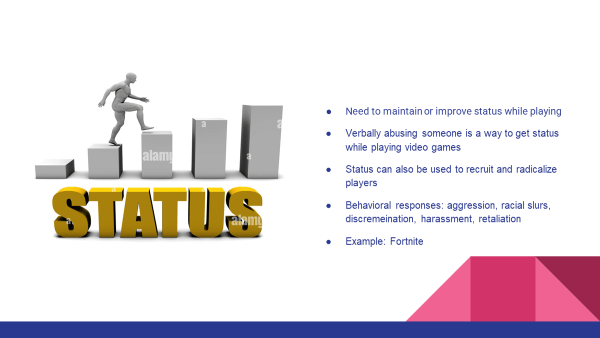
Like in the real world, the online world also has winners and losers in games. However, the online world creates incentive and reward structures that foster and promote strong competition amongst its players. Online gaming is a zero-sum game. Gamers play against each other or in groups and are ranked based on their in-game performance. Based on this, they earn points or ranking, which translates to a status. Status online can be achieved by rising in the ranks in the game, beating each level of the game and getting to higher levels, achieving more kills, having better aim or achieving specific tasks outlined in the game.
As gamers encounter other players that challenge their ability and gaming skills, they may lose their status. Some players go as far as throwing social norms out the window and bully other players or cheat to gain status. (Leaders, 2019). This fierce competition creates an environment that encourages bullying and harassment, with rank found to be the most common motive for cyberbullying (Ballard & Welch 2017). Status can also be used to recruit and radicalize players. Lack of status can force some behavioral responses like aggression, racial slurs, discrimination, harassment and even retaliation. Gamers who resort to cyberbullying engage in verbal, visual and relationship aggression such as name-calling, flaming, harassment, outing, embarrassing photos or memes and stalking (Ballard & Welch 2017). This need to achieve a higher status fuels the kinds of behaviors that can increase the likelihood of stereotyping and prejudice in online gaming.
Citations:
Ballard, M. E., & Welch, K. M. (2017). Virtual warfare: Cyberbullying and cyber-victimization in MMOG play. Games and culture, 12(5), 466-491.
Leaders, RL. 2019. The Social Order Behind Video Games. https://www.rlleaders.com/the-social-order-behind-video-games/
 Site Title