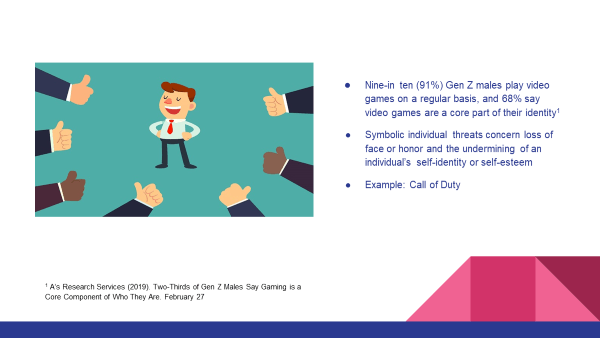
Another factor unique to online gaming is this feeling of individual identity, self-worth or self-esteem. In fact, 68% of Gen Z males who play video games on a regular basis say that video games are a core part of their identity (Strauss, 2019). Gamers have a lot of different components that make up their identity. Their identity can reflect their race, gender, age, sexuality, ethnicity, personality, religious beliefs and much more. Gamer identity has been found to foster a sense of belongingness and self-esteem especially as it promotes higher levels of social and psychological investment within gaming communities (Kowert, Vogelgesang, Festl & Quandt, 2015). Also in Massive Multiplayer Online (MMO) games, the strength of the gamer identity of the players has been found to be positively related to their self-esteem (Kaye, Kowert & Quinn, 2017).
A gamer’s identity can also reflect their ideological beliefs and can reinforce prejudices and stereotypes. If this sense of identity is threatened or undermined, either by losing a game or being shot down by an opponent, it represents a symbolic threat to the individual. It can be perceived as loss of face or honor and undermine an individual’s self-identity or self-esteem. Similarly, stereotypes in video games are more likely to be internalized because, unlike movies and television, video games allow a player to “become” a game character. When one takes on a virtual identity and repeatedly interacts with other characters, the stereotypes in video games begin to stimulate a new level of prejudicial reinforcement. (Deskins, 2013).
Citations:
Deskins, T. G. (2013). Stereotypes in video games and how they perpetuate prejudice. McNair Scholars Research Journal, 6(1), 5.
Kaye, L. K., Kowert, R., & Quinn, S. (2017). The role of social identity and online social capital on psychosocial outcomes in MMO players. Computers in Human Behavior, 74, 215-223.
Kowert, R., Vogelgesang, J., Festl, R., & Quandt, T. (2015). Psychosocial causes and consequences of online video game play. Computers in Human Behavior, 45, 51-58.
Strauss, A. (2019). Two-Thirds of Gen Z Males Say Gaming Is a Core Component of Who They Are. 4 A’s.
 Site Title