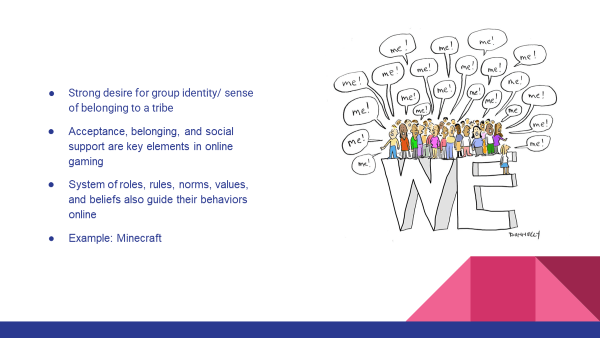
While people can create multiple online gaming identities, they also crave to be part of a group. They want to feel accepted because humans are fundamentally “tribal” in nature (Clark, Liu, Winegard & Ditto, 2019). This is especially manifested in online gaming, where “tribes” are created based on the games people play. Acceptance, belonging, and social support, as well as a system of roles, rules, norms, values, and beliefs guide their behaviors online (Stephan, Ybarra & Morrison, 2016). In online gaming, groups get formed based on different (or same) cultural or ideological beliefs. Groups us a form of provide grounding and certainty in the social world and our place within it (Abrams & Hogg, 1988). They also provide our lives with meaning by boosting our self-esteem (Crocker & Luhtanen, 1990). Because of this, we value being part of a group and we fear the consequences of the destruction of the group. As a result of this, at times of danger or when we sense some sort of threat, we are drawn towards our own “tribes” and favor them and at the same time exhibit hostility towards other groups (Branscombe, Ellemers, Spears, & Doosje, 1999; Tajfel & Turner, 1986).
“Tribes” in this case are online gaming communities that possess the power to harm or destroy various groups. As people feel loyalty to their tribe, they try to bring the people from the other tribes down. They do this by verbal abuse or even bullying (e.g., by killing other players or in the chatter between players). Playing consistently with the same group of people against other groups builds this sense of team identity and tribalism. Also, the online gaming world has a lot of situations in which groups are created due to exclusive membership rights or earning status after winning games. This grouping automatically leads to inclusion or exclusion of people. On the surface, one may not expect that these online gaming worlds would create some sort of tension among the groups or subgroups; but, in reality, the relationships between groups tend to be more competitive and even confrontational (Stephan, Ybarra & Morrison, 2016). A great example of this is in the game Valorant when being closer to your team when threatened can lead to a victory. This victory crushes the other team mentally.
Citations:
Abrams, D., & Hogg, M. A. (1988). Comments on the motivational status of self‐esteem in social identity and intergroup discrimination. European journal of social psychology, 18(4), 317-334.
Branscombe, N. R., Ellemers, N., Spears, R., & Doosje, B. (1999). The context and content of social identity threat. Social identity: Context, commitment, content, 35-58.
Clark, C. J., Liu, B. S., Winegard, B. M., & Ditto, P. H. (2019). Tribalism is human nature. Current Directions in Psychological Science, 28(6), 587-592.
Crocker, J., & Luhtanen, R. (1990). Collective self-esteem and ingroup bias. Journal of personality and social psychology, 58(1), 60.
Stephan, W. G., Ybarra, O., & Rios, K. (2016). Intergroup threat theory.
Tajfel, H., & Turner, J. C. (2004). The social identity theory of intergroup behavior. In Political psychology (pp. 276-293). Psychology Press.
 Site Title