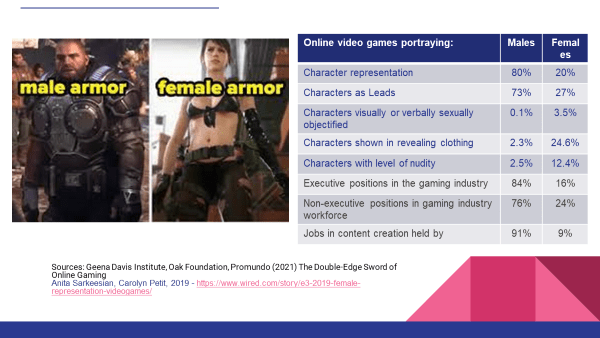
Gender stereotypes continue to prevail in online video games, with female characters barely or inaccurately represented: for example, only 5% of video games showcase female protagonists (Sarkeesian & Petit, 2019). Among all characters, male characters outnumber female characters four-to-one (80% males vs 20% females) and among leading characters, men make up the majority of 73% (Geena Davis Institute, 2021). Also, male characters are more likely to be the main hero or central to the game’s plot. Female characters are unevenly or inaccurately represented compared with male characters, with female characters often subordinate to the male hero of the game, relegated in background roles, portrayed as a love interest, innocent, needing to be rescued by a male, or objectified and hypersexualized with disproportionate body parts (Gestos, Smith-Merry & Campbell, 2018). This lack of, or incorrect, representation of women in video games leads to the propensity of video gamers to hold sexist attitudes towards women. Female and characters of color are represented as their stereotypical characters or are otherwise neglected or vilified, especially in games like The Legend of Zelda, Grand Theft Auto, NBA, and Metal Gear Solid V: The Phantom Pain (Harris-Lowe, 2017).
It is also important to note that White males create the majority of the online video games and they could be building their embedded unconscious biases into the games (Leonard, 2003). It is not just that the characters in the video games have a large male representation, this gender disparity is also evidenced in the workforce. This ensures that women’s voices or points of view are not evenly or accurately represented in video games. A study of the top fourteen global gaming companies reveals that men hold 84% of executive positions in the gaming industry, and outside of the executive ranks, only 24% are women (Wittenberg-Cox, 2020). Furthermore, in the gaming industry, 90% of content creation jobs are held by men and 81% of content creators are white, so it is no surprise that gender and race biases play out in artistic, design, and programming decisions (Johnson, 2014).
Citations:
Geena Davis Institute, Oak Foundation, Promundo (2021) The Double-Edge Sword of Online Gaming. https://seejane.org/wp-content/uploads/gaming-study-2021-7.pdf
Gestos, M., Smith-Merry, J., & Campbell, A. (2018). Representation of women in video games: A systematic review of literature in consideration of adult female wellbeing. Cyberpsychology, Behavior, and Social Networking, 21(9), 535-541.
Harris-Lowe, B. (2017). Gatekeeping: Women, people of color, and the video game community.
Johnson, R. (2014). Hiding in plain sight: Reproducing masculine culture at a video game studio. Communication, Culture & Critique, 7(4), 578-594
Leonard, D. (2003). “Live in your world, play in ours”: Race, video games, and consuming the other. Studies in Media & Information Literacy Education, 3(4), 1-9.
Sarkeesian, A., & Petit, C. (2019). Female representation in videogames isn’t getting any better. Wired. Retrieved from https://www. wired. com/story/e3-2019-female-representation-videogames.
Wittenberg-Cox, Avivah, 2020. Gaming Industry: Please Wait…Gender Balance Loading. Forbes magazine. https://www.forbes.com/sites/avivahwittenbergcox/2020/08/28/gaming-industry-please-waitgender-balance-loading/?sh=23ee61add304
 Site Title